
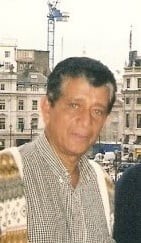
TRIBUTE- YACOOB GHANTY
“Our dead are never dead to us,
Until we have forgotten them”
It is with great sadness that we have learned of the passing away of Yacoob Ghanty after a long illness. He belonged to that generation that produced some brilliant minds that came back from mainly Europe after their studies and in their own way contributed to the development of the country, especially as we were facing a major change by acquiring our political independence from Britain.
Born in Port Louis in a family of traders specialising in textile products, he could have ended up joining the family business. But in primary school he showed enough prowess for his teacher to encourage him to follow an academic path. His hard work earned him the ‘petite bourse’ which took him to the Royal College Port Louis where he obtained his HSC certificate, and after that he made his way to the UK to pursue further studies for a Bachelor degree in English.
On his return to the motherland in the mid-sixties, he joined the Ministry of Education as English teacher where he made his mark. His former students still reminisce about how he made them love the English language and English literature. On another level he found the staff room a good place for discussions about the future of the country, especially with the young talents produced by our system of education. Yacoob was an anti-colonialist and he used to lock horns with people like Gaetan Raynal who used to think that with independence Mauritius would be doomed going down the same road as other African countries who had broken their links with colonial Britain.
Having made an impression as a teacher, he then went on to other pastures. With the Civil Service being developed, the government was trying to recruit the best administrators among the young graduates. Assistant Secretaries were being recruited by the PSC at that time, and Yacoob was among the top ten taken on. He was posted at the Ministry of Labour under Sir Harold Walter. To the latter’s question ‘What’s the boy doing in the corridor?’, Yacoob replied: ‘This boy has been hired by the Government to serve your Ministry, Sir, but has not been accommodated in a proper office since this morning’. SHW asked him to follow him to his office and he gave Yacoob a big book to read and give a summary of the content, which Yacoob dutifully did the next day, and that impressed SHW. They both became close and later intimate friends who would share drinks at the minister’s home. Yacoob would also prepare SHW’s dossiers for overseas missions, write his speeches and accompany him on foreign trips, much to the jealousy of his senior colleagues. When SSR asked SHW to prepare his UN speeches, of course Yacoob got the job!
The seventies was a period of instability and the era of protests. Yacoob was a great admirer of Che Guevara and was very perturbed by the worsening condition of the labouring masses. He joined the MMM. At the Crown Law Office he developed a cordial relationship with a man who was going to be the founder of modern Mauritius – Sir Aneerood Jugnauth.
After a decade abroad in Zambia and Libya where he taught English, he came back to Mauritius. He was introduced by SHW to Peter White, CEO of Lonrho, who employed him as Head of Labour Relations at Britannia Sugar Estate. There again he shone with his management acumen and he was often called upon when it came to big decisions being made. During his reign there were no labour disputes as he managed to solve to the satisfaction of all parties any conflict that arose. His strong belief in the role of the private sector would lead him on a collision course with the captains of industry, but as Peter White would often say to him when they had a discussion, ‘Have your way, Yacoob’. Later on his retirement he became a management consultant for several companies.
Yacoob was also the author of several books which revealed his vision and worldview. He did enjoy writing but unfortunately he never published his last project which was a book entitled “Christianity and Islam: 1000 years of Conflict”. Not only did he have a brilliant mind, but he could write so simply that people could understand his complex ideas.
His absence would be keenly felt by those who were close to him, as I was. We have lost a legend and we will miss his ingenuity.
I only hope that the numerous students here and abroad, the employees of the sugar industry and his juniors in the Civil Service, who have been inspired by him, continue to carry the torch for the betterment of the nation they serve.
Dawood Auleear