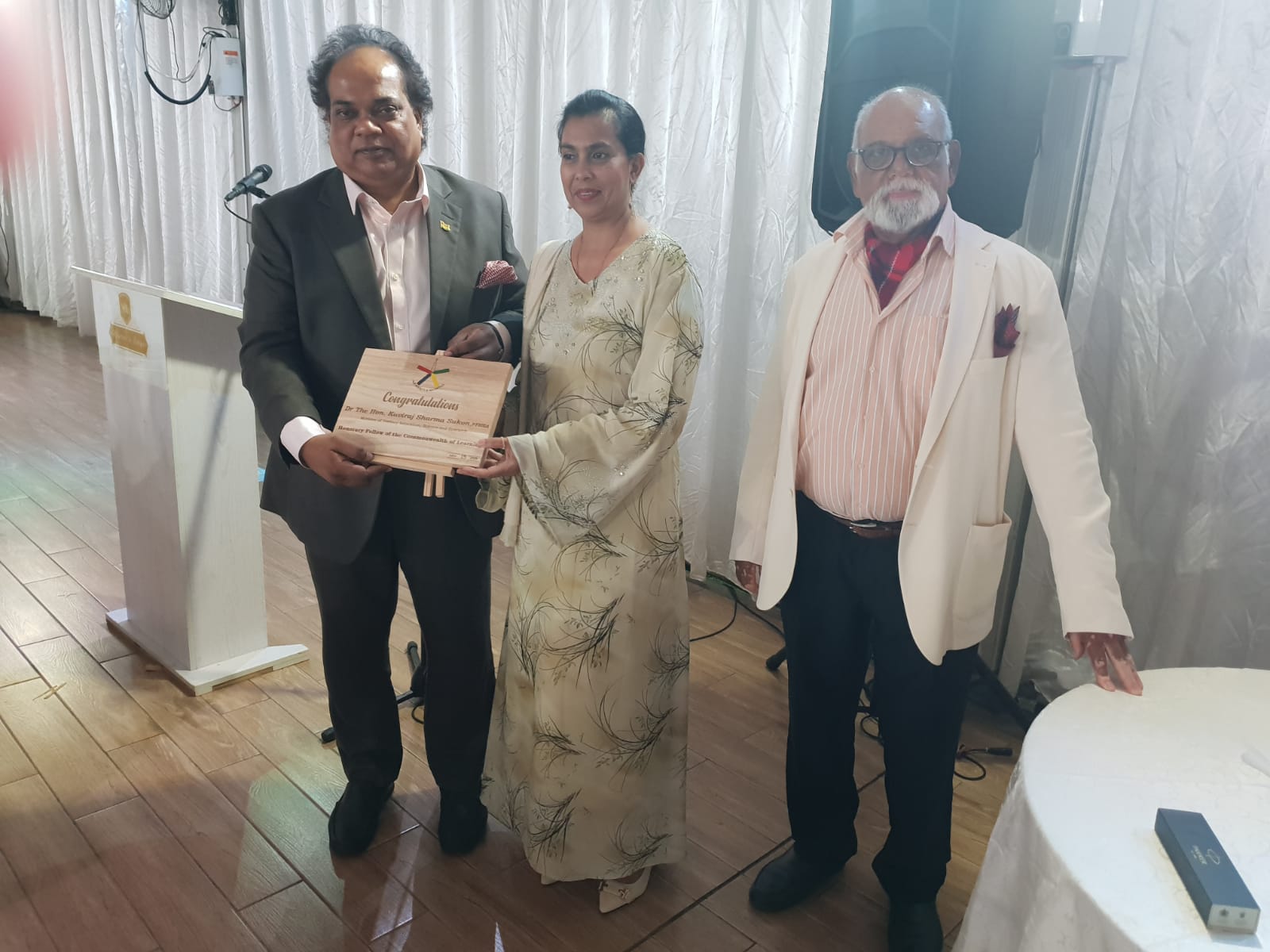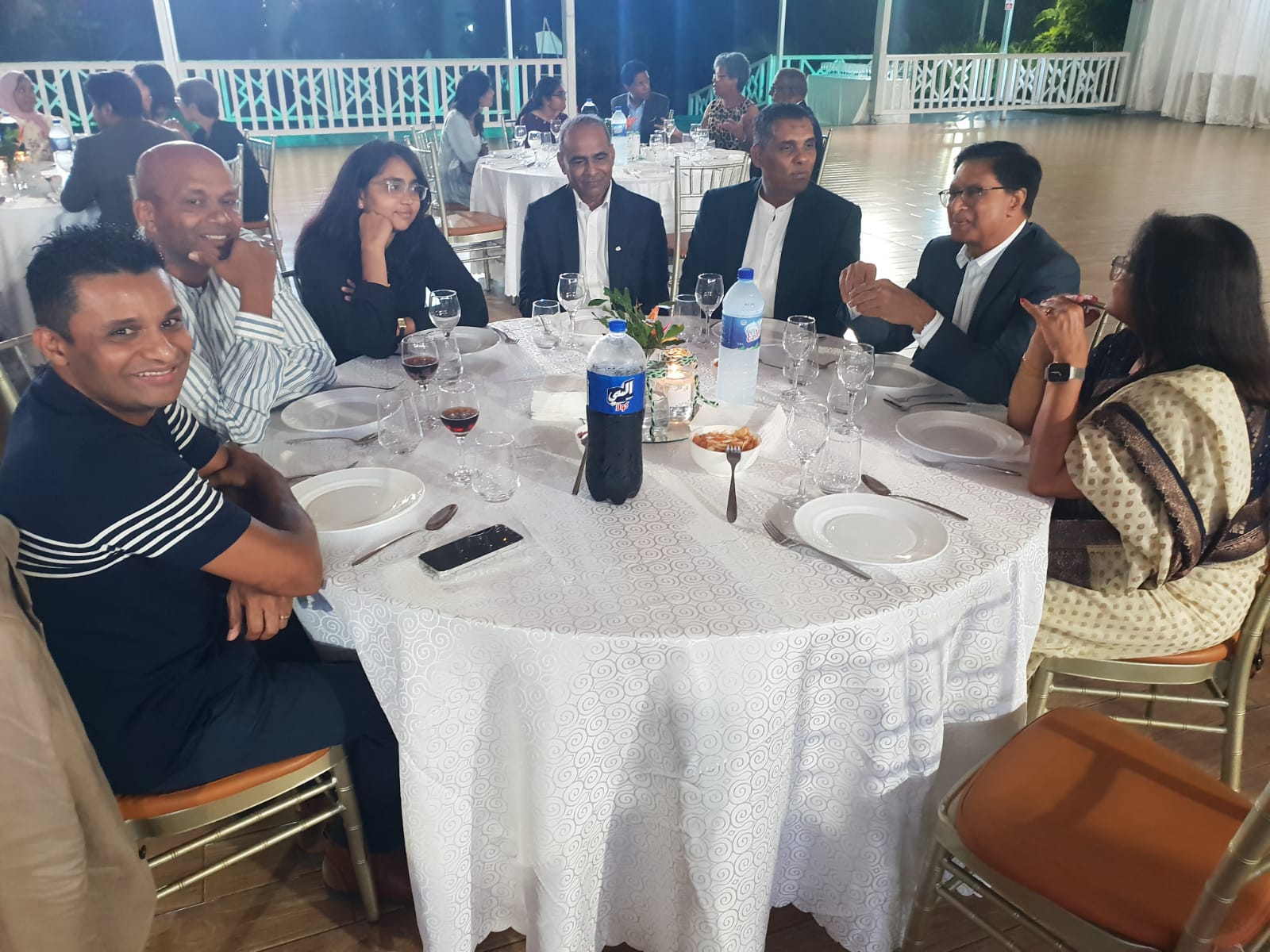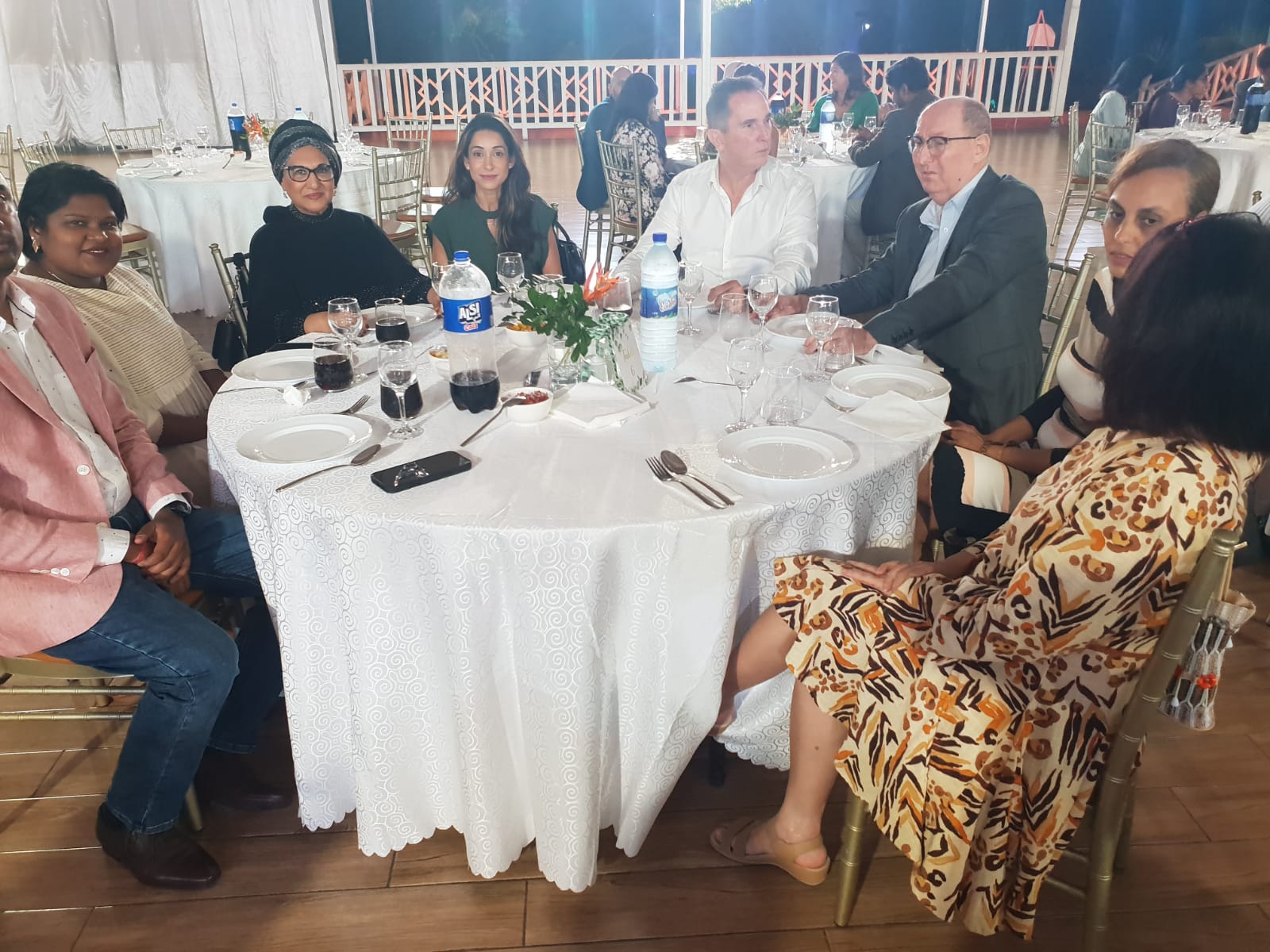
ALIF organised a reception in honour of Minster K. Sukon who was made Fellow of the Commonwealth of learning on Saturday 15 November 2025 among 100 guest at Water edge Garden.
The President made the welcome address requested Dr Sawkut Rojid to pay tribute to the Hon Minister.
SPEECH OF DR.ROJID
Distinguished guests, respected friends, ladies and gentlemen —
It gives me immense pleasure to stand before you today to honour a scholar, a visionary policy maker, and a national leader whose work continues to inspire generations of learners.
Dr. Kaviraj Sharma Sukon, Minister of Tertiary Education, Science and Research, on the occasion of his being conferred the title of Honorary Fellow of the Commonwealth of Learning.
This recognition from the Commonwealth of Learning, or COL, is not just a personal accolade; it is a moment of pride for Mauritius
This distinction is more than a personal recognition. It is also a tribute to the role that Mauritius has come to play in the Commonwealth and beyond — as a small island with big ambitions, driven by education, knowledge, and innovation.
The Commonwealth of Learning is one of the most respected institutions dedicated to promoting open, distance, and lifelong learning across more than fifty member states.
To be named an Honorary Fellow is a distinction reserved for those who have made truly outstanding and lasting contributions to education globally.
In this light, the honour bestowed on Honourable Sukon recognises not only his personal dedication but also the growing maturity of Mauritius as a knowledge-driven society.
Before entering public office, Dr. Kaviraj Sharma Sukon was already an academic and researcher of exceptional originality.
He is, in fact, credited with coining the term “blerning” — a creative blend of blended and e-learning — to describe an emerging learning model that fuses technology with human engagement.
“Blerning” captures his belief that while technology can expand access to knowledge, it must never replace the human connection at the heart of learning.
His groundbreaking research explored how learners — especially in small island developing states — adapt to distance and online education.
Long before the global pandemic brought e-learning into every household, he was already studying the psychological, social, and infrastructural dimensions of learning at a distance.
He also made major contributions to quality assurance, learner-centred instructional design, and policy integration — shaping how education systems can remain both inclusive and effective in an age of rapid technological change.
His work in open and distance learning has consistently promoted learner-centred pedagogy, where students are not passive recipients of knowledge but active participants in constructing their own understanding.
In short, how to make teaching personalised and ensure that the students own their learning process:
His research anticipated many of the challenges that education systems around the world are now confronting.
Ladies and gentlemen,
Mauritius today stands at an important turning point.
We can no longer rely solely on traditional sources of growth.
Our future rests on human capital, knowledge creation, and innovation.
In a world marked by constant disruptions— from AI to climate change — our resilience as a nation depends on our ability to learn faster, innovate smarter, and collaborate deeper.
We, as a nation, cannot compete on size, resources, or markets;
we must compete on ideas, skills, and creativity.
The future of our nation lies in how effectively we invest in the capabilities of our people and the institutions that nurture them.
It is in this context that the work of the Ministry of Tertiary Education, Science and Research becomes so critical. It is this Ministry that shapes the minds and technologies that will define the Mauritius of tomorrow.
Ladies and gentlemen,
As Minister of Education, Tertiary Education, Science and Technology, Honourable Sukon has carried his academic convictions into public policy.
He has led reforms that expand access to higher education, strengthen research capacity, and embed lifelong learning as a national ethos.
Under his leadership, Mauritius has seen a deepening of digital learning, the development of open universities, and the promotion of research-based policy making.
He has encouraged collaboration between academia, industry, and government, fostering innovation ecosystems where research leads to real-world solutions.
His approach demonstrates that education is not just a sector — it is an engine of transformation that drives inclusive growth, economic diversification, and social mobility.
This recognition from the Commonwealth of Learning, besides an honour, is also a reminder.
• It reminds us that research gains meaning when it changes lives.
• That education fulfills its mission when it empowers communities.
• And that innovation reaches its true potential when it serves humanity.
Honourable Sukon’s journey — from researcher to reformer — shows that intellectual rigor and public leadership can coexist, and together they can transform nations.
Honourable Minister,
Today we celebrate you — not only for being named an Honorary Fellow of the Commonwealth of Learning, but for embodying the very ideals that title represents:
• vision, commitment, and a lifelong passion for learning.
Your concept of “blerning” beautifully symbolises the future of education —
a future where technology and humanity blend, where knowledge meets empathy, and where learning never stops.
[pause – warm tone]
Alif Society extends its deepest congratulations and heartfelt appreciation.
May your leadership continue to guide Mauritius toward a smarter, more innovative, and more inclusive future — one where knowledge is our greatest asset and learning our proudest tradition.
Thank you.